
Release Notes 34.11.0
This release focuses on strengthening governance, performance, and operational visibility across the platform. Key highlights include the introduction of a Maker-Checker approval flow for Trigger and API changes to enhance control and auditability, improvements to Live Chat with inactivity flow reset to prevent unintended auto-resolve, and enhanced Live Chat Analytics with custom department grouping for better insights. Additionally, multiple dependency upgrades have been implemented to address security vulnerabilities, ensuring a more secure and stable platform overall.
New features and enhancements#
Added inactivity flow reset on agent interaction in Live Chat#
#KR-9672, #enhancement, #livechat, #inactivity
Introduced a new configuration to reset the inactivity flow when an agent sends a message between the second inactivity prompt and auto-resolve. Previously, the inactivity timer continued toward auto-resolve even after agent interaction, potentially closing active conversations prematurely.
With this enhancement, any agent input during this stage will reset the inactivity flow back to the first inactivity step. This ensures that auto-resolve is triggered only when intended, improving conversation continuity and preventing unintended session closures.
Updated dependencies to address CVE vulnerabilities and strengthen security#
#KR-9557, #enhancement, #security
Upgraded multiple npm dependencies and applied resolutions to address known security vulnerabilities and improve overall platform security. Key updates include:
- jsondiffpatch upgraded to ^0.7.2 to resolve CVE-2025-9910 (XSS vulnerability)
- qs upgraded to ^6.14.1 to fix prototype pollution issues
- Updated qs and tar-fs resolutions to secure versions
Additionally, enforced resolutions for several transitive dependencies to mitigate potential risks, including node-forge, jws, yargs-parser, nanoid, tmp, phin, uglify-js, natural, and redis.
These updates ensure safer dependency management, reduce exposure to known vulnerabilities, and maintain compliance with security best practices without impacting existing functionality.
Added Maker-Checker approval flow for Trigger and API changes#
#KR-9666, #feature, #marker-checker, #trigger, #api
Introduced a Maker-Checker approval mechanism for Trigger and API changes, extending governance controls beyond Content Nodes. Previously, these changes were applied directly to production without visibility or approval via the KeyReply dashboard, creating risks in auditability and change control.
With this feature, Trigger and API changes now follow the same controlled workflow as Content Nodes:
- Changes are staged and do not impact production immediately
- Client PICs can review changes via the Marker/Checker dashboard before approval
- Each change includes key details such as change type (Trigger/API), summary, author, and timestamp
- Changes are only applied to production upon explicit approval, and rejected changes are not deployed
The system also ensures a complete audit trail, capturing all approval actions (approver, action, timestamp) for compliance and investigation purposes. Existing Content Node approval flows remain unchanged.
This enhancement strengthens governance, prevents unauthorized or accidental production changes, and aligns with client expectations for controlled deployment—particularly in environments with multiple contributors and high operational sensitivity.
Added custom department filtering in Live Chat Analytics#
#KR-9932, enhancement, #supervisor, #livechat #analytic
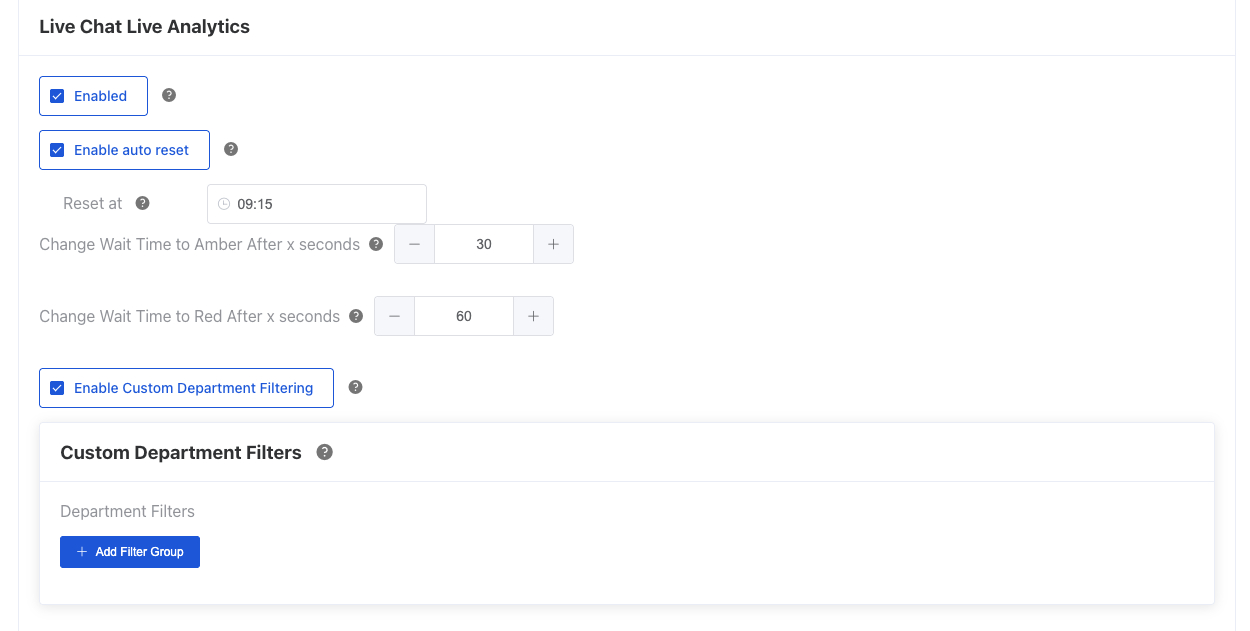
Enhanced the Live Chat Analytics feature by introducing support for custom department filtering. Previously, filtering was limited to individual agent departments. With this update, clients can now create custom department groups, allowing multiple departments to be combined into a single filter view.
This provides greater flexibility in analyzing chat performance across broader operational groupings, enabling more meaningful insights, improved reporting, and better alignment with organizational structures.